Language
Currency
Located in the center of Hue city, Tu Duc Tomb stands tall, exuding a strangely serene beauty while still retaining the majestic features of a royal dynasty of the past. Not as colossal and grand as other tombs, this place has a profound charm, resembling a clear lake reflecting the poetic soul of this king. If you are curious about this tourist destination, what are you waiting for? Join NVK travel to explore in detail in the following article.
Tu Duc Tomb is considered a top-notch architectural landscape of the Nguyen dynasty. Any tourist who has the opportunity to visit here praises the beauty it brings.
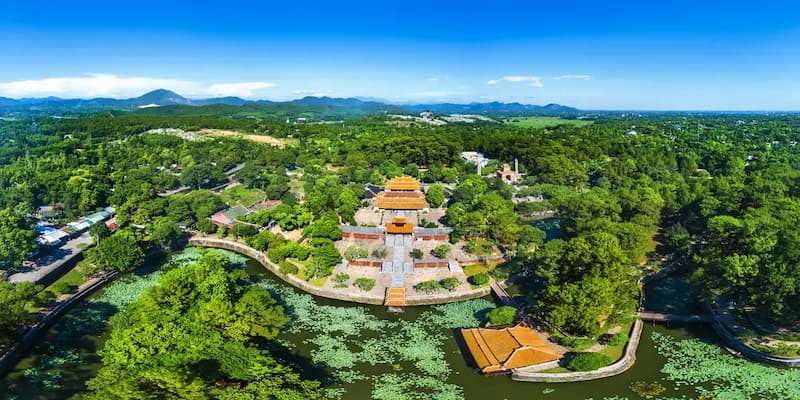
In terms of location, Tu Duc Tomb is quite close to the center of Hue city, about 7.5 kilometers to the southwest, nestled in a small valley on Doan Nhu Hai street, Thon Thuong Ba, Thuy Xuan ward. Surrounding this place is a cool atmosphere under the green pine trees and low hills.
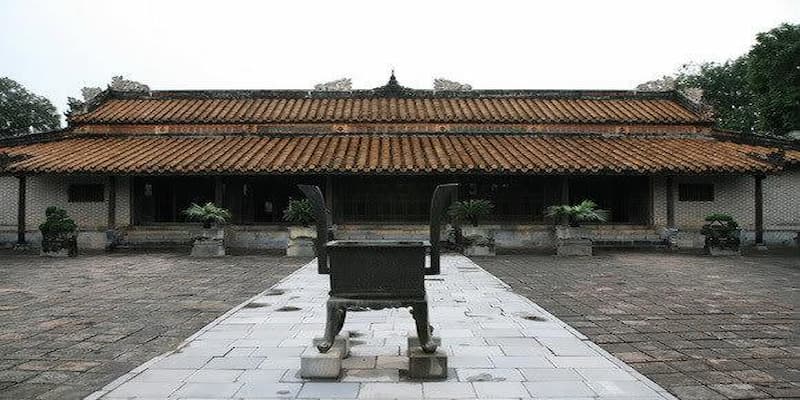
Tu Duc Tomb viewed from the front angle
>>> See more: Dai Noi Hue (Imperial City) Eternal Preservation Through Time
The road to Tu Duc Tomb is not as winding and difficult as one might think, so tourists can travel here by any means. If you enjoy the experience of "phuot", you can rent a motorbike or use ride-hailing services at a reasonable cost.
In case you want to admire the surrounding scenery before stepping into the tomb, visitors can also consider taking a taxi or personal car (if available). To conveniently get here using Google Maps, you can refer to the following route:
Easily access the tomb using specialized vehicles
>>> See more: Hoi An Market - Discover Unique Cuisine in the Heart of Hoi An
With the combination of a palace area and a unique tomb structure, Tu Duc Tomb has been completed. Specifically, this area covers more than 12 hectares, including about 50 large and small structures arranged harmoniously around Luu Khiem lake. The paths around the tomb resemble soft silk ribbons, making any sensitive soul "tremble" when stepping foot.
The structures in the tomb are mainly built from brick, stone, and lim wood, while the roof is covered with glazed tiles (Yin-Yang tiles). Delving deeper into the exploration, we can easily see two main areas called the main hall and the tomb. They do not lie on the same axis but run parallel to the terrain, leaning against Giang Khiem and Duong Xuan mountains as a backdrop, containing extremely high feng shui value.
In terms of decorative techniques, the structures in the tomb leave a strong impression due to the exquisite ceramic mosaic technique. You will be even more captivated when seeing the mosaics with bright colors, accented with warm colors like orange, yellow, or crimson and lotus pink. For the "cool colors", the builders skillfully placed colors like green, blue, and violet to create a perfect "ceramic mosaic" with all shades.
On the surface of the structures, the images of the Four Sacred Beasts, Eight Precious Weapons along with Chinese characters showcase the intricacy and absolute artistic quality of this tomb.
The tomb is a symbol of the long-standing history of the Nguyen dynasty
King Tu Duc was born in 1829 and passed away in 1883, his real name was Nguyen Phuc Hong Nham, the fourth emperor of the Nguyen dynasty. During this dynasty, he was the longest-reigning king, sitting on the throne for over 37 years. In his ideology, Confucianism was the dominant form along with poetry that shaped his somewhat poetic character.
During his reign, the king faced many upheavals, among which the greatest "pain" that he always carried in his heart until his death was the cession of three eastern provinces in 1862 and the entire Southern region to the French invaders (1867). Unlike any other tombs that were constructed after the emperor's death, Tu Duc Tomb was built while this king was still alive.
In 1863, the project was first launched, named Van Nien Co (Ten Thousand Years Foundation). Five years later, facing strong criticism from the court and the "Chay Voi Rebellion", this king renamed the project to Khiem Cung, officially completed in 1873. It wasn't until King Tu Duc passed away that this place was renamed Khiem Lang.
Tu Duc Tomb and the history of construction went through many name changes
Although he was a ruler of a whole country, King Tu Duc carried within him unspoken worries. Therefore, the design of the tomb somewhat reflects his life, expressing the buried sorrows. He had more than 103 concubines but sadly left no descendants.
Before the strong invasion from the colonial empire, having to "slice" the country like pieces of cake for the French invaders was like daggers piercing his heart. Those sorrows have permeated the design of the tomb, turning this place into a work that harmonizes the eye, solemn and slightly tinged with the melancholy of a glorious past in the heart of the ancient capital Hue.
The life of the king influences the structure of the project
Many people often think that Tu Duc Tomb is just a resting place and memorial for this Nguyen dynasty king. However, before that, this place used to be a palace where the king worked and rested for more than a decade.
In 1993, this site was recognized by UNESCO as a cultural heritage, part of the heritage complex of the ancient capital. Notably, this place also became the first historical site in our country to be featured and introduced in a 3D digital museum (a project by Google Art & Culture).
The tomb was recognized by UNESCO as a cultural heritage
In the following sections, NVK travel will introduce you to some impressive structures around Tu Duc Tomb.
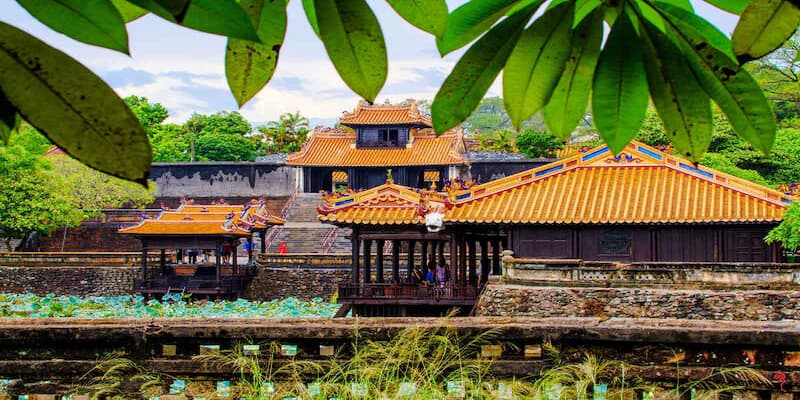
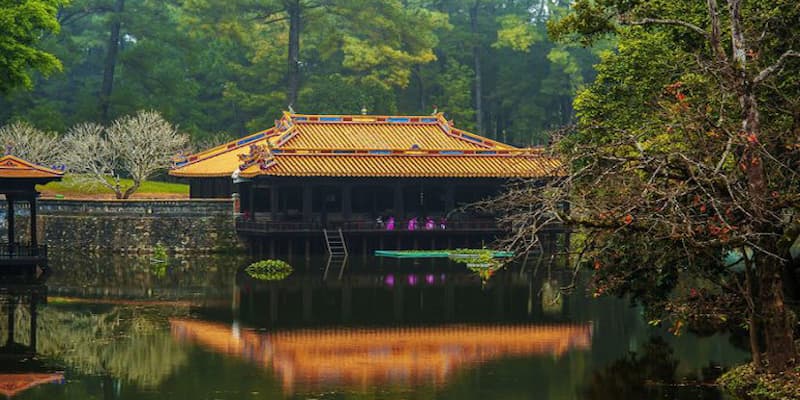
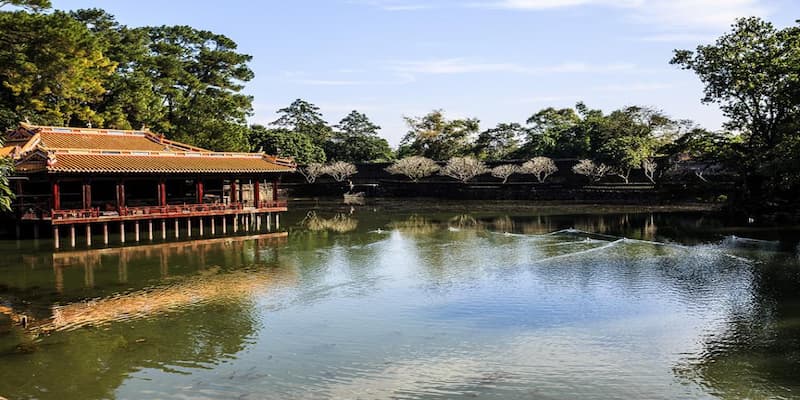
Luu Khiem Lake is located at the center of the tomb, playing a role in feng shui similar to a "minh duong". In the middle of the lake, the appearance of Tinh Khiem Island creates an extremely sharp highlight, making the surrounding space become strangely picturesque.
Luu Khiem Lake and Tinh Khiem Island have high feng shui value
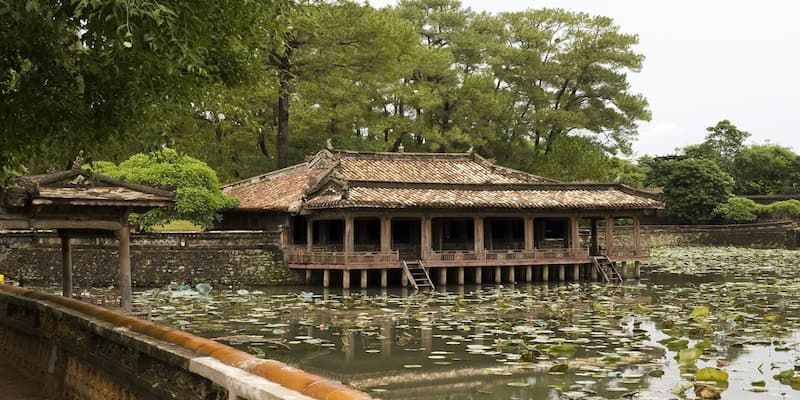
This was where the king often came to read books, compose poetry, and rest after work. Specifically, Xung Khiem Ta is located on the left side of the lake, impressing with its "layered" architecture with many couplets and poems of King Tu Duc, including those of King Thieu Tri. Du Khiem Ta is a wharf created for leisurely boating on the lake.
The scenery surrounding Xung Khiem Ta and Du Khiem Ta
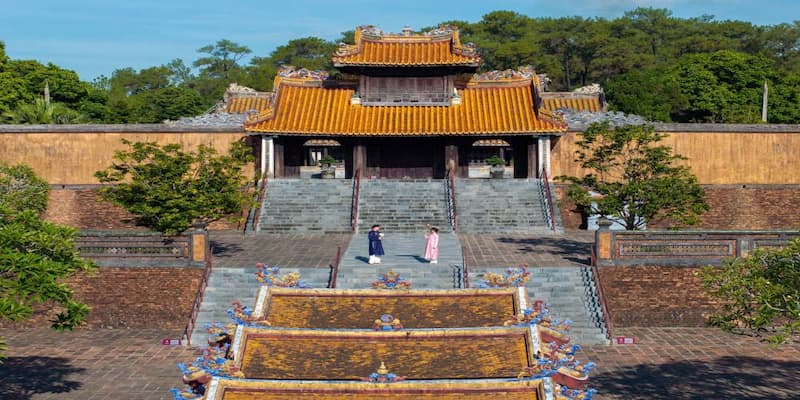
Facing Luu Khiem Lake, the appearance of Khiem Cung Mon astonishes tourists with its two-story gate design in the style of a watchtower. This main gate leads to the main hall, where the king rests.
Khiem Cung Mon still captivates visitors with its yin-yang tiled architecture, resembling the traditional pointed shoes of the Nguyen dynasty. At the eaves, the image of "two dragons worshiping the moon" contributes to the exquisite craftsmanship, symbolizing spiritual significance of favorable weather.
Khiem Cung Mon with its serene and poetic beauty
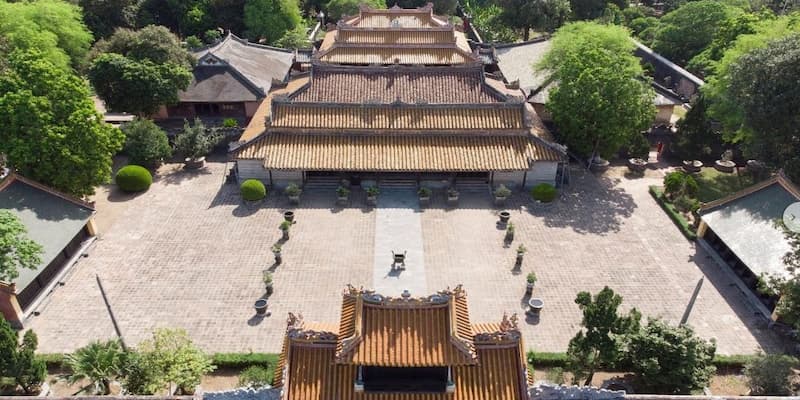
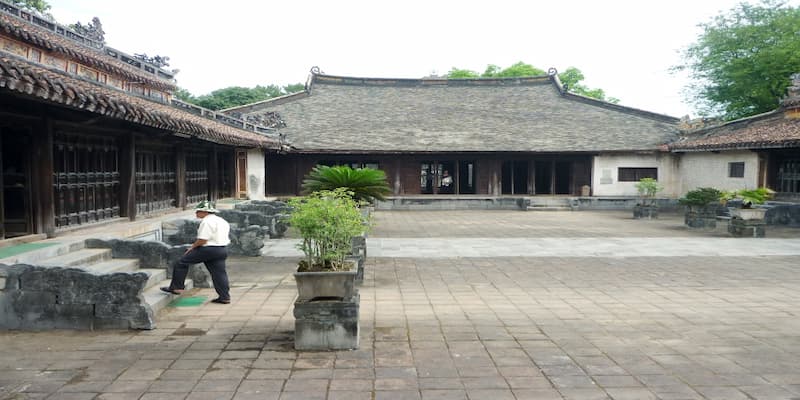
Hoa Khiem Dien is located at a relatively high and airy position in the center of the Tu Duc tomb. The architecture of the hall features a three-bay two-winged ancient structure, with massive wooden pillars standing tall, and the roof covered with glazed tiles and intricately carved eaves. This hall was previously the emperor's workplace, and after his passing, it became the place for worshiping the altars of Emperor Tu Duc and Empress Le Thien Anh.
Hoa Khiem Dien with its beautiful and intricate structure
In the tomb area, the prominent constructions surrounding include Bai Dinh, Bi Dinh, Tru Bieu, and Buu Thanh. Bai Dinh is a spacious courtyard, flanked by two rows of stone statues of civil and military officials, elephants, and horses, all exuding solemnity. Bi Dinh is the stele located at the end of Bai Dinh (the largest in our country weighing 20 tons). On this stele, nearly 500 characters of Khiem Cung Ky composed by Emperor Tu Duc have been engraved.
Tru Bieu consists of two large stone pillars located behind Bi Dinh, representing the soul akin to an eternal torch of the king. Behind Bi Dinh is Tieu Khiem Lake, an artificial lake shaped like a crescent moon. Finally, Buu Thanh is the main tomb area of the king, constructed with solid stones surrounding it. In front and behind the tomb are screens including the front screen (placed in front) and the longevity character (placed behind) to ward off bad luck.
Through this article, we have provided readers with the most detailed information about the Tu Duc tomb. The tomb exhibits the architectural beauty of a complex royal palace, with the internal spatial arrangement interconnected like a vibrant art form. Adorned with beautiful landscapes surrounding it, this site attracts thousands of visitors each year. If in the future you have a needto travel to Hue, do not hesitate to connect with NVK Travel for support and tour guidance.
Fill out the form and we will contact you