Language
Currency
Imperial City of Hue (Royal Citadel) is one of the famous tourist destinations attracting many visitors from both domestic and international locations. It takes visitors back to the feudal era with the scenery vividly recreated. This article from NVK Travel will equip you with the necessary knowledge to visit the Imperial City of Hue fully.
The Royal Citadel of Hue, also known as the Imperial City of Hue, is the second wall within the Hue Citadel. The Imperial City of Hue (Royal Citadel) was built to shield and protect the most significant positions in the court, such as palaces, ancestral temples, especially the Forbidden Purple City, which was reserved for the emperor and the royal family.
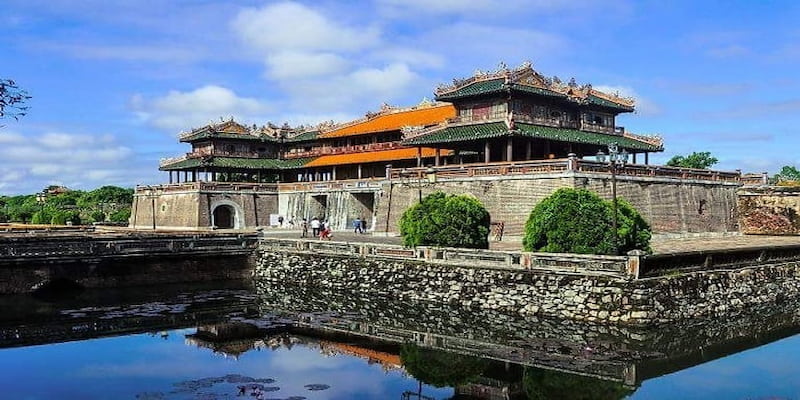
The Royal Citadel of Hue is located on 23 August Street, in Thuan Hoa Ward, Hue City. It lies next to the famous Perfume River, known for its poetic and dreamy beauty right in the center of Hue City. The Royal Citadel of Hue has a circumference of nearly 10,000m and an area of 520 hectares. The walls are 6.6m high, with 10 entrances, and there are 24 forts on the walls, along with a system of moats and canals for protection.
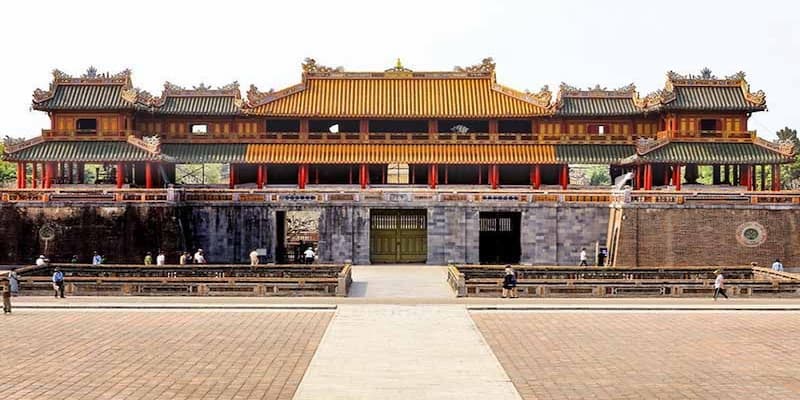
Imperial City of Hue from a frontal view
>>> See more: Hoi An Market - Discover Unique Cuisine in the Heart of Hoi An
The Imperial City of Hue (Royal Citadel) was constructed in 1804 during the reign of Emperor Gia Long, but it was not until 1833, under the reign of Emperor Minh Mang, that the Royal Citadel of Hue was completed with a total of 147 structures.
The citadel is designed with a nearly square layout, each side measuring about 600 meters, 4 meters high, and 1 meter thick. All directions have protective moats and there are 4 gates for entry and exit, with the main gate being Ngo Mon, and the other three gates are Hien Nhan to the East, Chuong Duc to the West, and Hoa Binh to the North.
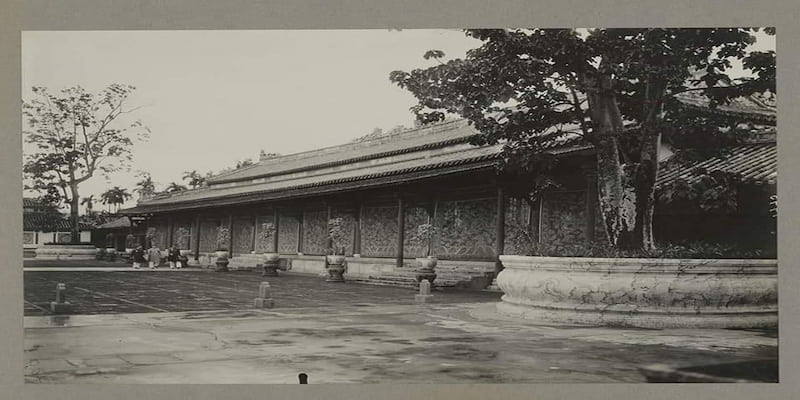
The Imperial City of Hue has a history spanning hundreds of years
>>> See more: Kim Bong Wood Village Hoi An - Explore the Hundred-Year-Old Wood Village
With its location in the center of Hue City, getting to the Imperial City of Hue (Royal Citadel) is very simple. Visitors in the city center who want to reach the Royal Citadel just need to walk along the southern bank of the Perfume River, cross Phu Xuan Bridge, turn onto Le Duan Street, and then turn right onto Cua Quang Duc. Continue along the small bridge, and visitors will arrive at 23 August Street.
After that, visitors just need to go straight along this road and pay attention to the right side to see the Imperial City of Hue. Tourists can park their vehicles outside and walk inside.
Travelers can reach the Imperial City of Hue in various ways
To visit the Imperial City of Hue (Royal Citadel), tourists must purchase an entrance ticket. The newly updated ticket prices include 3 different rates. The ticket price is 120,000 VND for adults and 30,000 VND for children, while foreign tourists pay 150,000 VND per person. The ticket price includes admission to the museum and the Imperial City of Hue.
The opening hours of the site will be every day of the week, from Monday to Sunday. Specifically, the opening hours during the day will vary by season. In the summer, the opening hours will be from 6:30 AM to 5:30 PM. In the winter, the opening hours will be shorter, from 7 AM to 5 PM.
Visiting the Imperial City of Hue at surprisingly low ticket prices
The Imperial City of Hue (Royal Citadel) is one of the beautiful "historical marks" of the Nguyen dynasty that still exists today. In the following sections, NVK Travel will introduce you to some interesting structures within the Royal Citadel that are sure to leave a deep impression.
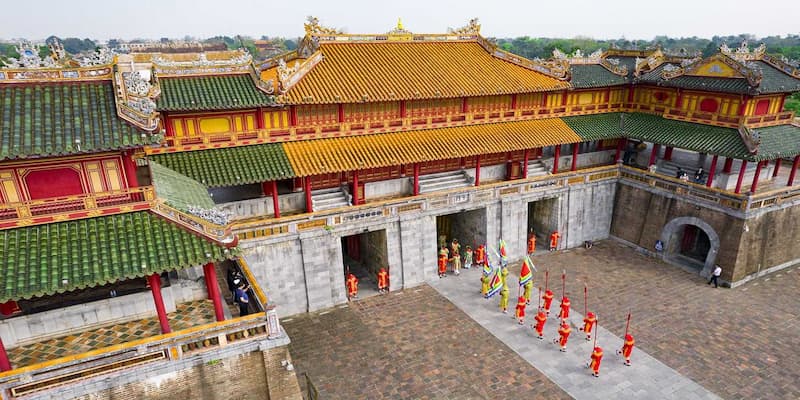
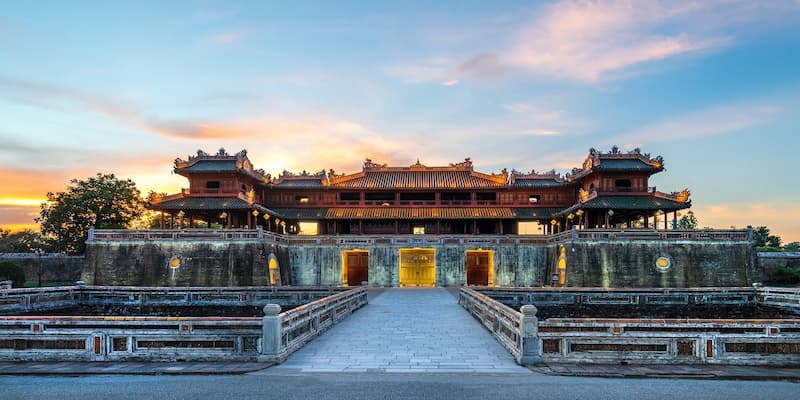
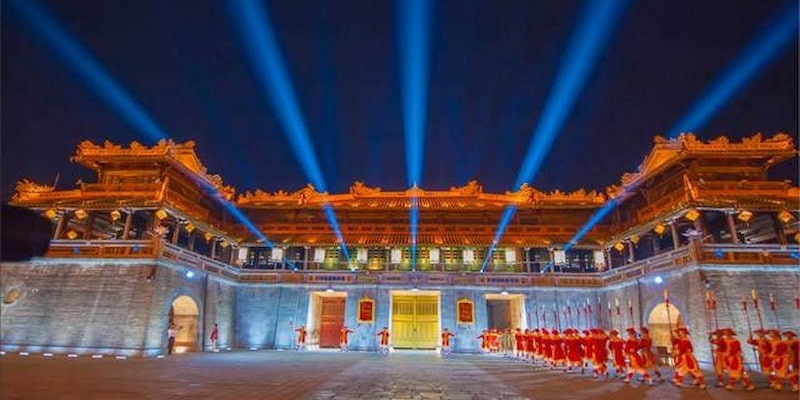
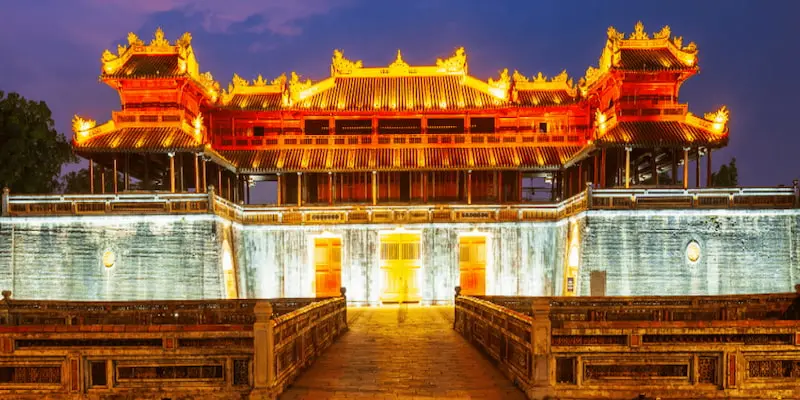
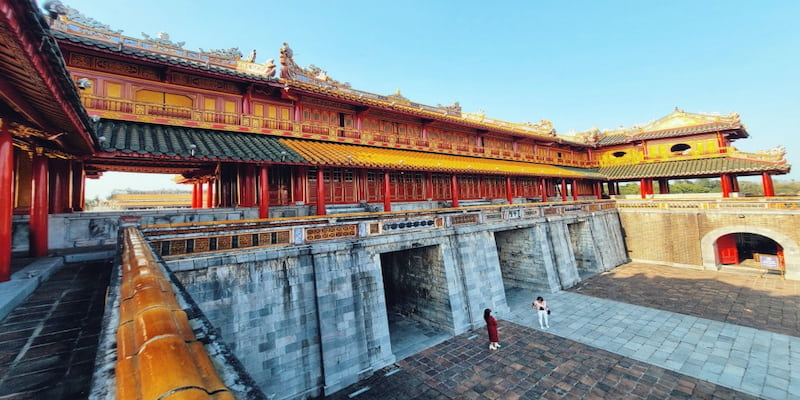
Ngo Mon is the main gate of the Royal Citadel, built during the reign of Emperor Minh Mang 14 (in 1834). The gate is located on the southern side of the citadel, and the name Ngo Mon signifies its meaning, which is the Gate facing the Ngo direction (South), a direction reserved for emperors according to the principles of the I Ching.
Due to its special significance, Ngo Mon is also constructed as the largest gate among the 4 gates of the Imperial City of Hue (Royal Citadel). Besides the main gate for the emperor, there is another gate called Cua Chuong Duc to the West, primarily used for the ladies of the court to enter and exit.
The beauty of Ngo Mon captivates tourists
Thai Hoa Palace is a palace located within the Imperial City of Hue (Royal Citadel). The palace, along with the Dai Trieu Nghi Courtyard (or the court yard), is used for significant ceremonial occasions in the court, such as the emperor's birthday, the coronation ceremony, and occasions to welcome envoys.
Thai Hoa Palace was constructed in 1805 during the reign of Emperor Gia Long. However, in 1833, Emperor Minh Mang relocated and renovated the palace to make it more magnificent.
Thai Hoa Palace exudes the majesty of emperors
The Forbidden Purple City is a special area that serves as the daily living center for the emperor and the royal family of the Nguyen dynasty within the Imperial City of Hue (Royal Citadel). The Forbidden Purple City was established in the 3rd year of Gia Long (1804) and was further restored by the Nguyen emperors.
In Chinese characters, 'Tu' means purple, but according to mythology: in the sky, there is the Tu Vi Garden, and the emperor is considered the son of Heaven, so the emperor's residence is also called Tu. The Forbidden City is an area where commoners are prohibited from entering.
The Forbidden Purple City carries a nostalgic beauty
Can Chanh Palace is where the emperor held regular court sessions and handled state affairs. Can Chanh Palace was built in the 3rd year of Gia Long (1804). The emperor would hold court on the 5th, 10th, 20th, and 25th of the lunar month.
Can Chanh Palace features the largest and most beautiful wooden architecture in the Forbidden Purple City. The platform is about 1 meter high, with a foundation area of nearly 1000 square meters reinforced and completed using the technique of laying bricks and stones.
Can Chanh Palace impresses visiting tourists
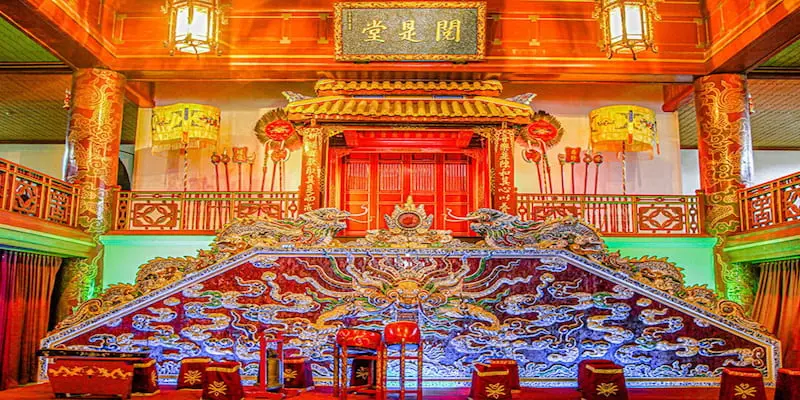
Designed as a royal theater for the emperor, royal relatives, and noble officials within the Imperial City of Hue (Royal Citadel), Duyet Thi Duong is intricately and beautifully designed. This is where performances of traditional operas are held for officials and envoys to enjoy.
The theater was built in the 5th year of Minh Mang (1824-1826). The theater has a total area of 11,740 square meters, supported by two rows of high lim wood columns about 12 meters tall, adorned with intricate dragon and cloud motifs, divided into 2 beautifully ornate tiers.
The largest ancient theater in Vietnam named Duyet Thi Duong
Within the Imperial City of Hue (Royal Citadel), there are three important palaces designated for the empress and noble concubines:
The To Temple or The Temple is located at the southwest corner of the Imperial City of Hue (Royal Citadel). This is the place to worship the kings of the Nguyen dynasty and to conduct rituals for the deceased kings in the court; however, women in the court (including queens) were also not allowed to attend ceremonies here.
The Imperial City of Hue is a heritage site not only of Vietnam but also recognized by UNESCO as a world cultural heritage. Just that is enough to prove the cultural depth and influence of this landmark. NVK Travel has provided you with the most useful information so that you can fully visit the Imperial City of Hue.If you want to travel Hue fully, don't hesitate to contact us for tour guidance, creating a wonderful experience of exploring the Royal Citadel.
Fill out the form and we will contact you