Language
Currency
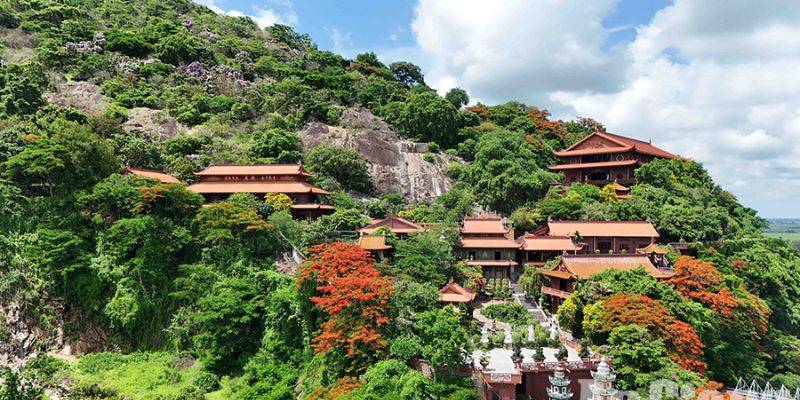
Hang Pagoda (Phuoc Dien Tu) is one of the most famous spiritual destinations in the Sam Mountain area, Chau Doc, An Giang. With harmonious architecture, the pagoda offers a serene space along with long-standing cultural beauty. Not only is it a place for sacred worship, but it also provides a stunning view, becoming an ideal stop for travelers exploring the Mekong Delta.
When traveling to An Giang, there is a famous pagoda nestled against Sam Mountain, which is Hang Pagoda (Phuoc Dien Tu). The name “Phuoc Dien” carries a profound meaning, “Phuoc” means blessing, and “Dien” refers to fertile land. This implies that this place nurtures good intentions and accumulates virtue.
Hang Pagoda (Phuoc Dien Tu) is an extremely famous pagoda in An Giang.
>>> See more: Cable Car to Nui Cam - The Journey to Explore the Sacred Peak
The pagoda is located on a high and airy mountainside, so when visiting, travelers can find tranquility amidst nature and enjoy a panoramic view of the Chau Doc region from above. Thanks to its special location and long-standing historical values, Hang Pagoda has been recognized as a National Historical - Cultural Site. It has become a must-visit destination whenever travelers and Buddhists come to Sam Mountain.
The atmosphere at Hang Pagoda (Phuoc Dien Tu) always brings a sense of lightness, with the sound of temple bells echoing through the mountains and the cool breeze blowing through the stone steps leading to the main hall,... In addition to pilgrimage and worship, visitors can easily combine their visit with other equally famous attractions nearby.
Visitors will feel peaceful and serene when coming to the pagoda.
In the heart of the majestic Sam Mountain, Hang Pagoda (Phuoc Dien Tu) stands as a historical witness, preserving many stories about the virtues, resilience, and faith of the people of An Giang. The pagoda is a stop for those seeking peace, and it also symbolizes loyalty and the will to overcome adversity.
The origin of Hang Pagoda (Phuoc Dien Tu) dates back to around the years 1840 - 1850, associated with the life of Nun Dieu Thien (real name Le Thi Tho). After many upheavals in her family life, she decided to leave behind worldly suffering to seek the path of cultivation. Upon arriving in the Sam Mountain region, she built a small hut made of bamboo and thatch. Her sincere intention towards goodness and her determination laid the first bricks for this famous pagoda.
Hang Pagoda has a long-standing origin.
>>> See more: Discover the Architectural Beauty of Tay Ninh Holy See
By 1885, impressed by the pure heart and virtue of the Nun, Mr. Pham Thong (Nguyen Ngoc Cang) along with the local people contributed to rebuild the pagoda. This collaboration clearly reflects the spirit of solidarity and respect for the one who established this sacred land.
Over time, the pagoda continued to be restored. Notably, in 1937, Venerable Thich Hue Thien once again restored and expanded the pagoda, giving it a more solid and solemn appearance. Since then, Hang Pagoda (Phuoc Dien Tu) has been renovated many times, becoming an architectural work that is both ancient and enduring over time.
The ancient pagoda rests quietly beside Sam Mountain.
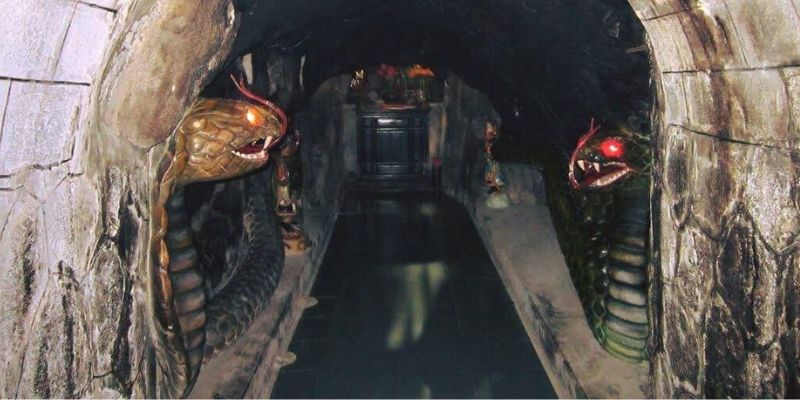
Hang Pagoda (Phuoc Dien Tu) has long been famous for its serene beauty amidst the mountains and forests. Additionally, there are captivating legendary stories that have been passed down by local people through generations. Among them, the legend of the divine snakes Thanh Xa - Bach Xa is considered the most remarkable story.
According to ancient tales, when Nun Dieu Thien sought out the back of Sam Mountain to build her hermitage, there was a large cave nearby. This was originally the dwelling place of two giant, fearsome snakes. The local people at that time were very wary of this area because the pair of snakes often appeared aggressive.
The special legend about the pair of Thanh Xa - Bach Xa snakes.
However, since the Nun began her practice, a strange occurrence took place; the snakes not only posed no danger but also became unusually gentle. Whenever the Nun recited sutras, they would quietly slither to lie in front of the cave as if listening to the pure sound of the sutras. Their presence was seen as a sign of protection, keeping peace for Hang Pagoda (Phuoc Dien Tu) - the small place of cultivation in its early days.
The Nun later named them Thanh Xa and Bach Xa, symbolizing balance and harmony between the elements of heaven and earth. At the same time, they also represent compassion in the Buddhist teachings. Even more strangely, right after Nun Dieu Thien passed away, the pair of snakes disappeared without a trace. The locals believe they have completed their mission of protecting the pagoda and followed the Nun to another realm.
The pair of snakes has become a symbol of Hang Pagoda.
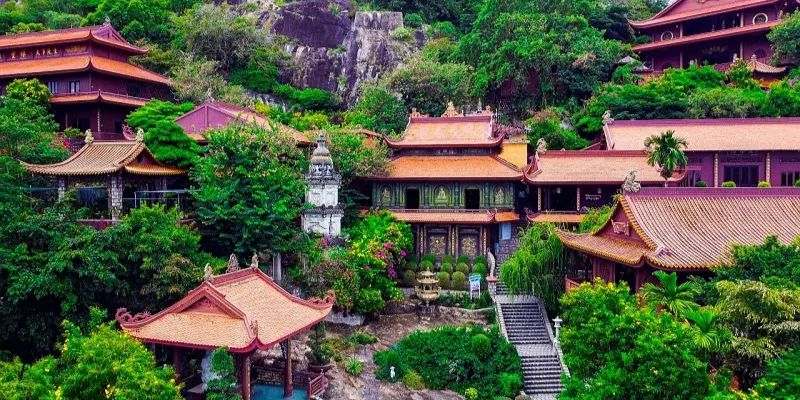
Nestled on the slopes of Sam Mountain and facing the vast space of the That Son region, Hang Pagoda (Phuoc Dien Tu) possesses a rare serene beauty. Thanks to being surrounded by lush vegetation year-round, the atmosphere here is always fresh and pleasant, providing visitors with a sense of relief from the moment they arrive.
At the foot of Sam Mountain, the large gate of Hang Pagoda (Phuoc Dien Tu) is always open wide, like a peaceful greeting to those seeking the Buddhist sanctuary. If you do not use the cable car of the tourist area, you will begin your journey by conquering about 300 meters of stone steps to reach the main grounds.
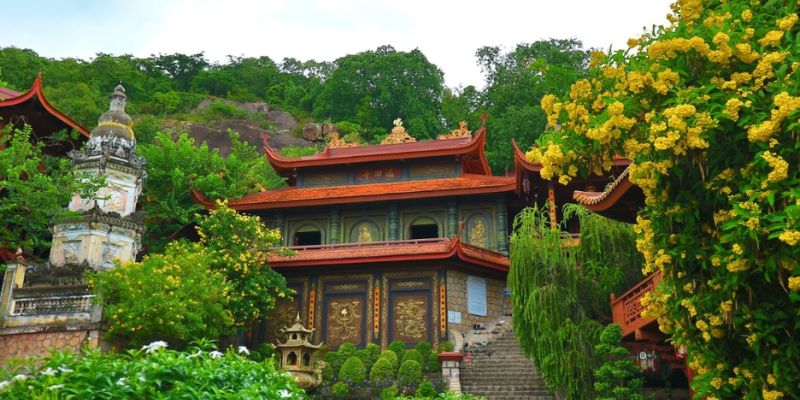
The pagoda grounds with many shady green trees.
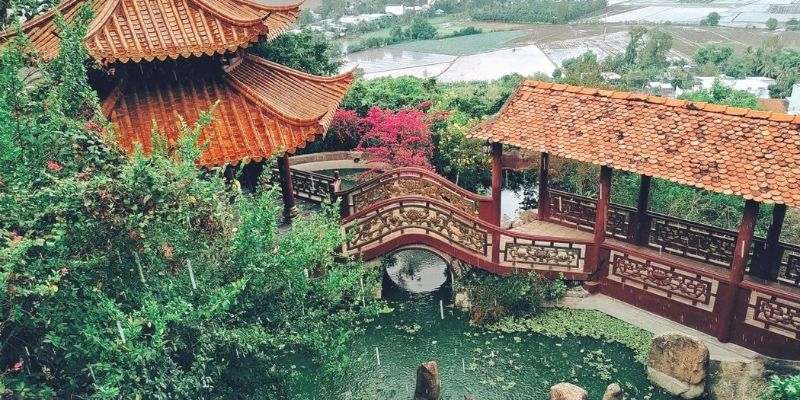
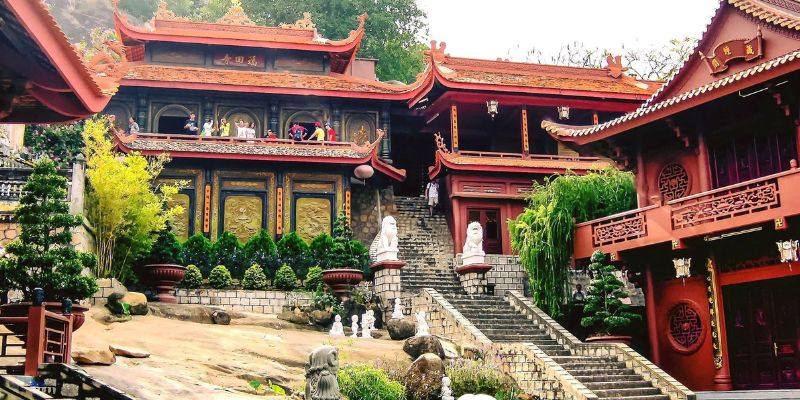
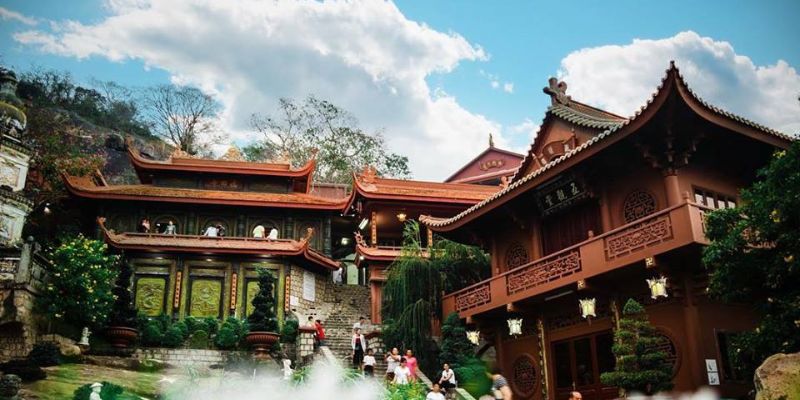
On that path, just stop and look up, and you can have a panoramic view of Chau Doc city from above. Upon arrival, you will clearly feel how Hang Pagoda (Phuoc Dien Tu) harmonizes artificial architecture with natural landscapes. The red-tiled roofs shine under the sun, and the wooden columns are painted and gilded, all appearing majestic yet not detached from the green of the mountains and forests.
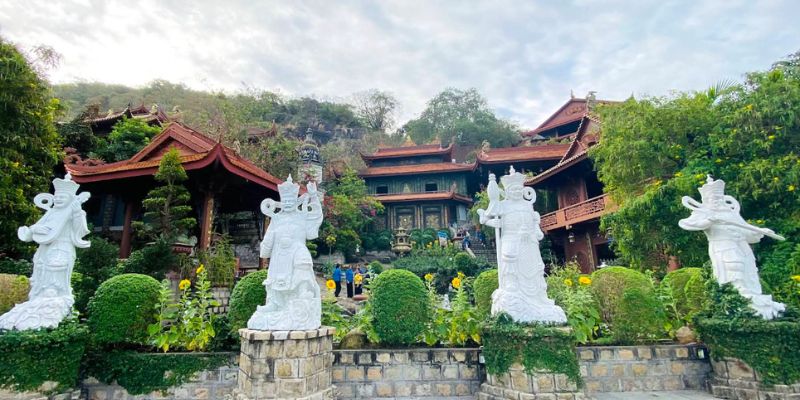
Through many renovations, the pagoda has retained its ancient beauty thanks to the intricate carvings that reflect the meticulousness and dedication of generations of monks. Within the grounds, the pagoda also features altars for the Laughing Buddha, Avalokiteshvara Bodhisattva, and four Guardian Deities, creating a sacred whole. Locals and visitors often come to pray for peace, good fortune, and tranquility in their souls.
Statues of the four guardian deities are located right in front of the grounds.
Stepping through the main hall's door, visitors will immediately feel the majesty of this long-standing place of worship. The facade of the main hall impresses with its balanced design, with a width of about 11m and a depth of 10m. This space is where the Three Jewels altar is placed, where locals and visitors sincerely offer incense to pray for peace and blessings.
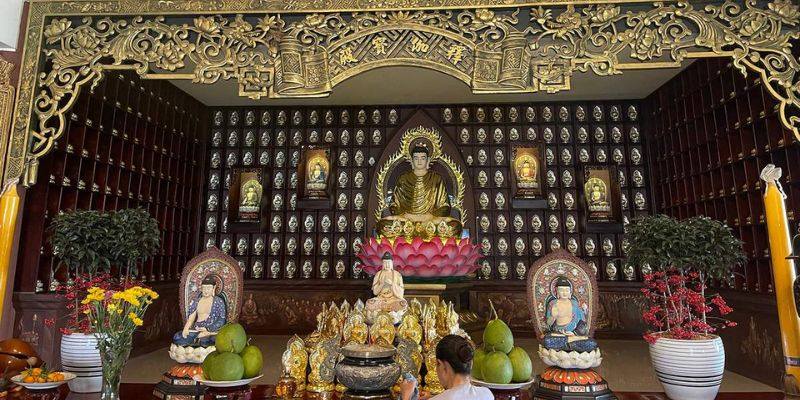
The most special feature in the main hall of Hang Pagoda (Phuoc Dien Tu) is the reflection effect of the Buddha statue. No matter what angle you stand at, you can see the image of the Buddha appearing through many layers of reflection. This creates a feeling of being enveloped in a realm of meditation – where light, incense, and the image of the Buddha merge into a sacred space, both real and surreal. This miraculous quality makes many people feel their souls soothed, and all worries seem to dissipate upon entering this place.
The main hall is where locals and Buddhists come to worship and pray for good luck.
Not only stopping at the main hall, Hang Pagoda (Phuoc Dien Tu) also impresses with small paths leading deep into the natural cave. Along the cool stone walls, Buddha statues are placed solemnly, each statue bearing a different expression. On the path, you will encounter the statues of the Thanh Xa and Bach Xa snakes placed on either side like guardian deities guarding the sacred realm.
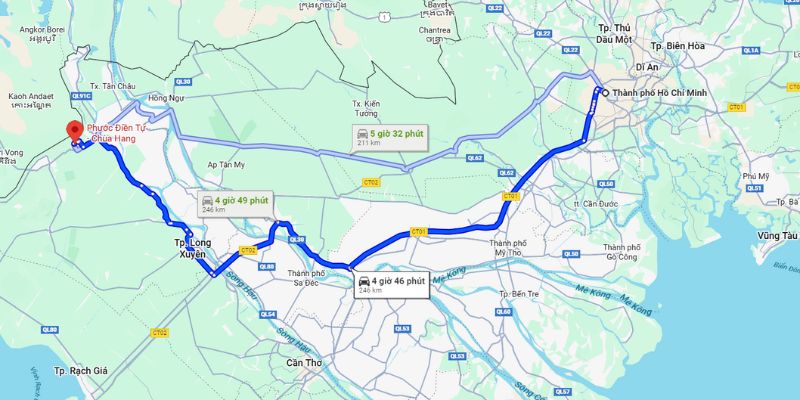
If starting from Ho Chi Minh City, travelers can begin their journey from the Western Bus Station and take a bus to Chau Doc, with a travel time of about 6-7 hours depending on the type of bus. Upon reaching Chau Doc, travelers continue their journey along National Highway 91, then turn onto Ly Thuong Kiet Street, following the signs to Sam Mountain.
Route for travelers to refer to when visiting the pagoda.
At the foot of the mountain, you will see a specific guide sign to Hang Pagoda (Phuoc Dien Tu) in the tourist area. From here, you can walk up to the pagoda or use the electric vehicle provided by the tourist area to save energy, especially if traveling with family or elderly people. For a smooth journey, it is advisable to start in the morning to have time to combine visiting other notable points on the mountain.
Visiting Hang Pagoda (Phuoc Dien Tu) offers an experience that combines a spiritual journey with the majestic natural beauty of Sam Mountain. For a safe and convenient trip, travelers should choose the professional travel services of NVK Travel. With a dedicated and experienced team, NVK Travel will accompany you, making each journey to An Giang a complete and memorable one!
Fill out the form and we will contact you