Language
Currency
Dam Pagoda - an ancient temple regarded as the birthplace of Buddhism in Vietnam. The space here is solemn, steeped in cultural depth, serving both as a place of worship and a valuable architectural and historical heritage. Thus, the pagoda has always been a sacred destination for those seeking to return to the spiritual roots of the Kinh Bac region.
Dam Pagoda, also known by various local names such as Ram Pagoda, Ba Tam Pagoda, Cao Pagoda, or Tram Gian Pagoda (not to be confused with the pagoda of the same name in Hanoi), is officially named Dai Lam Than Quang Tu. Located on Lam Son Mountain, locals sometimes casually refer to it as Lam Son Pagoda.
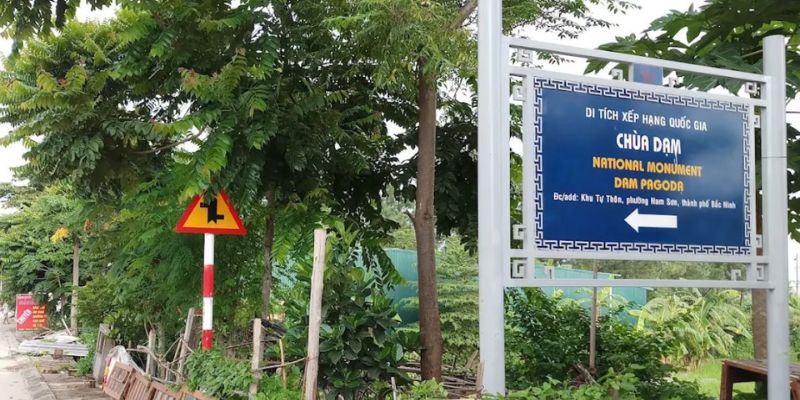
Dam Pagoda is located in Nam Son Ward, Bac Ninh City.
>>> See more: Van Mieu Dieu Hoa Lake: A Cultural Green Space in the Heart of Bac Ninh
This ancient temple rests against the slope of Dam Mountain, facing the gentle Duong River. In the past, this area belonged to Lam Son Trung Commune, Lam Son Nam District, Que Duong County. It has now become Nam Son Ward of Bac Ninh City, Bac Ninh Province.
Dam Pagoda is a prominent scenic spot established during the Ly Dynasty, carrying nearly a millennium of history. The pagoda is classified among the typical monuments of significant cultural and religious value in the Kinh Bac region.
The pagoda has a long historical imprint over hundreds of years.
>>> See more: Tieu Pagoda - Discovering the Place that Preserves the Cultural Values of the Ly Dynasty
Ancient documents such as Viet Su Luoc, Dai Viet Su Ky Toan Thu, Dai Nam Nhat Thong Chi, and Lich Trieu Hien Chuong Loai Chi all record that Dam Pagoda was founded in the first year of the Quang Huu reign (1085). It was in the tranquil Dai Lam Mountain that Princess Y Lan found inspiration to establish this great temple.
Construction began in 1086 and was completed in 1094. The wooden block of Dai Viet Su Ky Toan Thu, volume 3, simply notes, "Build a pagoda on Dai Lam Mountain." During the construction period, King Ly Nhan Tong personally visited several times to inspect and enjoy the scenery of the pagoda. Historical records state that in October of the year Dinh Mao (1087), the king held a banquet here for the court officials. This event is mentioned in the Kham Dinh Viet Su Thong Giam Cuong Muc.
The construction was carried out during the Ly Dynasty.
The construction of the pagoda lasted nearly 20 years, involving many massive projects. In the year Mau Thin (1088), the king directed the construction of a stone tower within the pagoda grounds. By the year Giap Tuat (1094), the main tower was completed, becoming one of the most large-scale and exquisite Buddhist structures of the Ly Dynasty. Not stopping there, in the year At Dau (1105), King Ly Nhan Tong ordered the construction of three additional stone towers, further highlighting the role of Dam Pagoda as the foremost center of worship in the ancient capital.
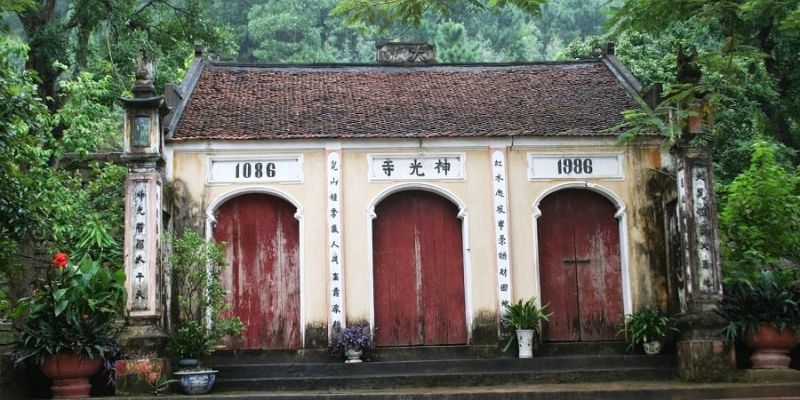
Throughout many dynasties, the pagoda has been continuously restored and expanded, becoming a significant spiritual anchor for the Kinh Bac region. However, during the resistance against the French, the entire ancient architecture was completely destroyed. In 1986, local residents rebuilt a small three-room pagoda on the old foundation to honor the Buddha.
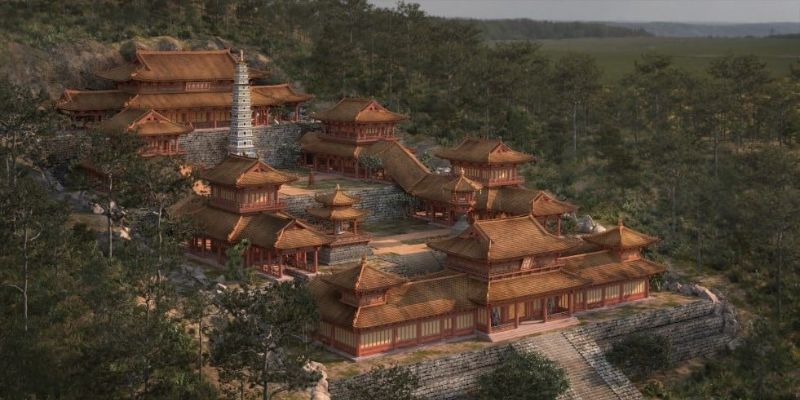
The reconstructed image of the pagoda during its most prosperous period.
Dam Pagoda was classified as a historical and cultural site by the Ministry of Culture and Information on January 13, 1964. In 2015, Bac Ninh Province mobilized social funding and implemented a conservation and restoration project for the site, covering an area of about 198 hectares, with a total investment of 260 billion VND. The new construction has been rebuilt elegantly while retaining the ancient spirit along with a system of statues and offerings that possess high aesthetic value, reflecting the distinctive art of many historical periods.
Visiting Dam Pagoda, travelers can immerse themselves in the ancient atmosphere, rich in religious and worship elements. At the same time, it is also a place that preserves long-standing historical values and artifacts.
The beauty of the thousand-year-old ancient temple.
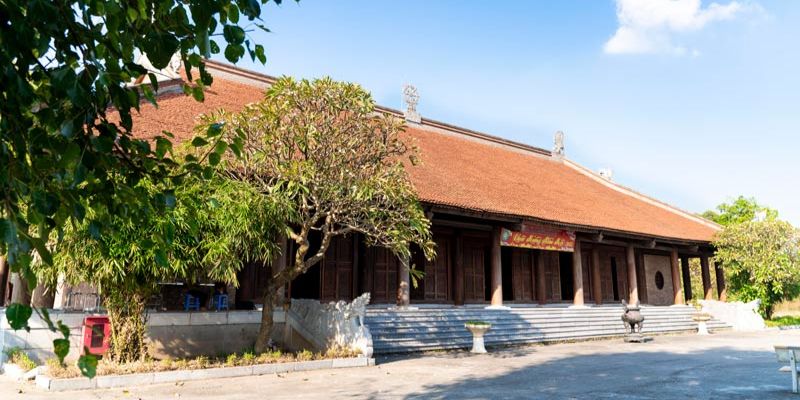
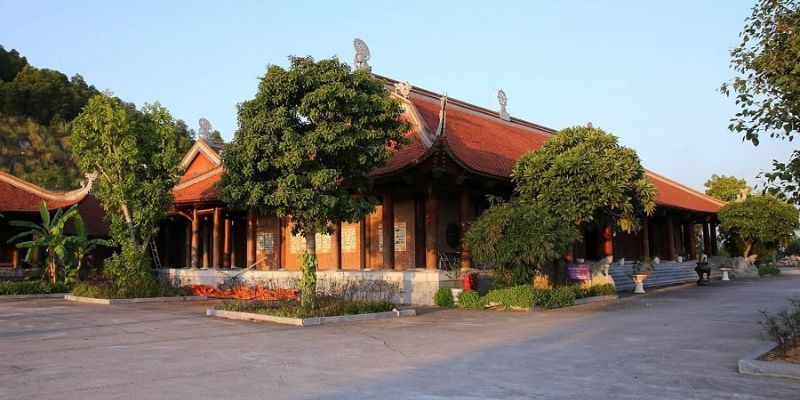
The architecture of Dam Pagoda showcases a harmonious beauty between the ancient style of the Ly Dynasty and the grandeur of the structure restored in modern times. Previously, the pagoda was famous for its large scale, arranged according to the principle of resting on the mountain and facing the water, built high on the mountainside and gradually sloping down with a system of stone steps meticulously carved into square blocks.
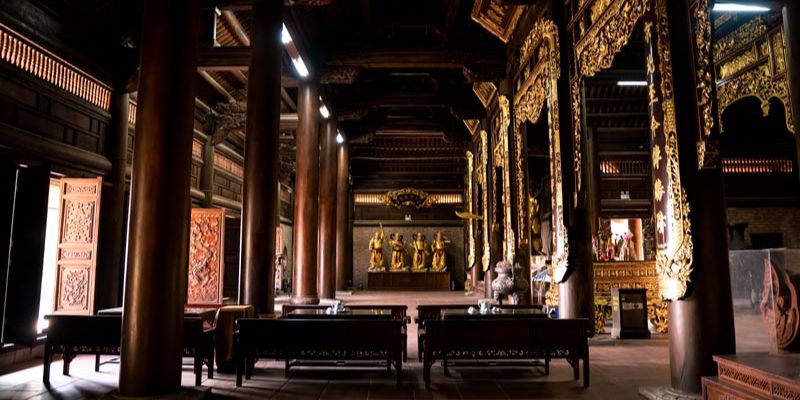
Today, the Tam Bao area is built in the shape of the character Cong (I), consisting of three main parts: the Front Hall - Incense Offering - Upper Hall. The entire architecture uses sturdy lim wood, highlighted by intricate carvings and traditional decorative techniques.
The characteristic architecture of temples combined with exquisite sculptures.
On both sides of Tam Bao are the Ancestor House and Mother House arranged symmetrically, each with 3 compartments, 2 wings, and gracefully curved roofs, with a sturdy wooden frame similar to the main architecture. The system of doors opens across all 7 compartments, combined with brick walls featuring "Tho" character-shaped windows. This creates a space that is both solemn and close, in line with the spirit of traditional Vietnamese architecture.
The compartments are combined with sturdy lim wood columns.
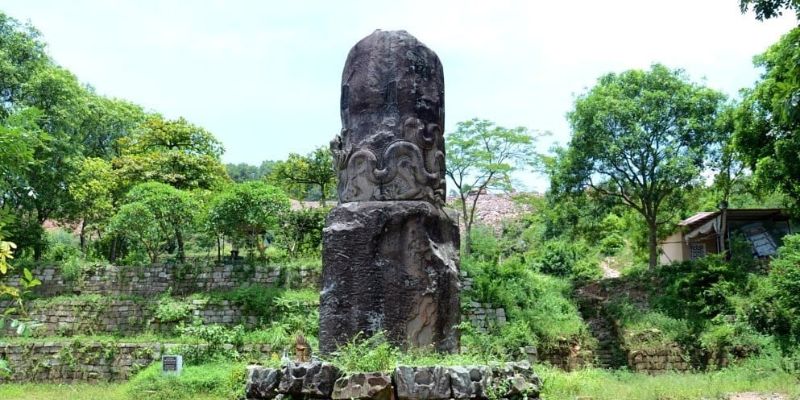
The most prominent artifact in the collection of Dam Pagoda is the ancient stone pillar, recognized by the state as a National Treasure in 2017. The pillar is about 5 meters tall (not including the broken top), consisting of two parts: a square block of stone below combined with a layer of stone cladding, and above is a round pillar with a diameter of 1.5 meters.
On the surface of the pillar, intricately carved pairs of dragons with intertwined tails, gracefully undulating bodies, and heads raised high gazing at a pearl. Along with that are meticulously crafted lotus petal patterns at the base of the tower, showcasing the essence of Ly Dynasty sculpture. Additionally, the space of Dam Pagoda is adorned with a rich collection of worship statues, creating an atmosphere that is both sacred and majestic.
The ancient stone pillar is recognized as a National Treasure.
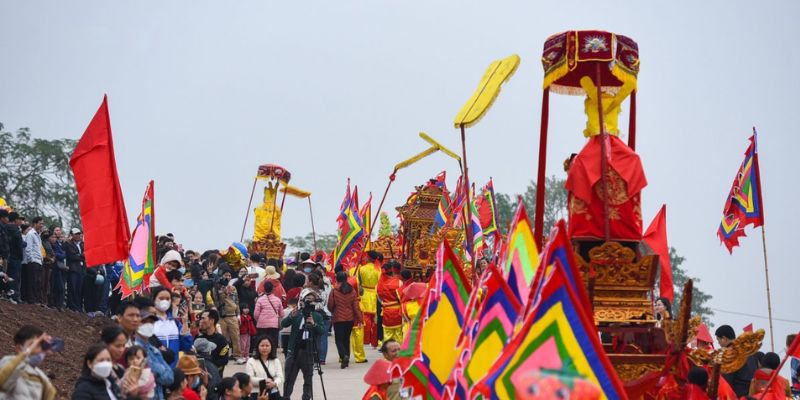
An unmissable part of exploring Dam Pagoda is participating in festival activities rich in spiritual colors. The Dam Pagoda Festival is held on the 8th day of the 9th lunar month, a time for locals and Buddhists to offer prayers for peace, health, and prosperity.
In addition to the traditional festival, Dam Pagoda also welcomes visitors during the full moon days, the first day of the month, Buddha's Birthday, Vu Lan Festival, or Tet Nguyen Dan. This is an ideal time for visitors to fully experience the tranquility and participate in Buddhist rituals.
The Dam Pagoda Festival takes place in the 9th lunar month.
To visit Dam Pagoda in Bac Ninh, travelers can choose from various flexible transportation options according to their needs. Specifically as follows:
Transportation options and routes to the ancient temple.
Dam Pagoda is truly a precious gem that the people of Kinh Bac are always proud of, preserving history for thousands of years. The journey of experience.memorable travel to Bac Ninh, explore the beauty of cultural beliefs and exquisite architecture always ready at NVK Travel. Contact us for advice, support, and to book your experience tour today!
Fill out the form and we will contact you